The Coalition Against Rogue Riding (C.A.R.R.) demands strict enforcement of traffic regulations for all street vehicles, including bicycles, and supports measures that will enable these regulations to be enforced reliably and efficiently.
Here you have a paid acolyte of the False Green God engaging in serial sophistry according to the playbook of Transportation Alternatives. The disruptors and the profit mongers. An illegitimate enterprise from the initial importation of the bike program. Without establishing a responsible bike culture. Suppressing the enforcement of the NYPD and undermining their authority. Setting the table for world class congestion. Causing in 2017 $35 billion in LOST NYC business. I think we see what the "green wave" consists of Polly. You inherit the mantle of public offender from Janette S Khan. Now conveniently succored in the warm wallet of Bloomberg Enterprises. Bully Bully.
Subject:
Trottenberg Op-Ed Exclusive: Riding the ‘Green Wave’ —
and the Choppy Waters Ahead – Streetsblog New York City
Garlick gives us the flavor of the vigorous expansion of the C bike and most other ride share programs across the USA. Mr, Ross is currently enjoying a boycott of Equinox, Soul Cycle and possibly Blink workout clubs.("Health is the new wealth") all Related Co properties. Ross is majority owner of Related-includes The Miami Dolphins NFL team. It becomes eminently clear that with
big bucks backers like Ross-who now infamously donated $6 million dollars to fellow developer Donald Trump's campaign and Towers Financial hedge fund operator Mark Gorton( liable for $105 million from lawsuit by Recording Industry of America)-ALSO Towers F was once run by Stephen Hoffenberg-did nearly 20 years for a Ponzi scheme-Hoffenberg was mentor to the recently deceased
Jeffry Epstein-birds of a feather and all that. Its clear that this is far from a promotion of a people's mode of transportation. The "false green God" is driven by profit. The desire to undermine the NYPD
and an apparent desire to outstrip Robert Moses in the game of who has the biggest ego and the tightest riding shorts.
They're boycotting equinox and soul cycle. Someone just asked why not citi bike?
The W 15th St Block Association behind Attorney Arthur Schwartz brought reason and balance to
the radical plan put forward by the NYCDOT and Transportation Alternatives. NYTET said the court. Months of a stay to find a better way.
What a difference a few hours make.
Late this afternoon, the Court of Appeals issued another temporary restraining order against the DOT. The city cannot touch 14th St. for MONTHS!
Big thanks goes to Arthur Schwartz whose
dedication and commitment to our neighborhood is the reason there will
not be a line of traffic down our block on Monday morning.
Congratulations Arthur. And thank you so very very much.
Since when do bike riders have a license to kill? They don't even need a license.
R.I.P. Michael. Fellow New Yorker. A victim of the of the reckless disregard for human life
perpetrated by Transportation Alternatives and off shoots. Would be appropriate to have them be liable-and the politicians who enable the irresponsible bike culture.
Manhattan man struck by hit-and-run cyclist dies from injuries
A 60-year-old man struck by a hit-and-run cyclist in the
Flatiron District last week has succumbed to his injuries, cops said
Wednesday.
Michael Collopy was standing in a bike lane at Sixth Avenue and 23rd
Street when a cyclist heading north in the lane rammed into him and kept
going at about noon on July 31, cops said.
Collopy, who lives a few blocks from the scene, died Monday at Bellevue Hospital.
The city Medical Examiner’s Office said Wednesday it had determined that Collopy’s official cause of death was the collision.
Police said they are looking for the cyclist, but couldn’t immediately provide a description.
Collopy’s death left his Chelsea apartment-building doorman stunned.
“He was one of the good ones in the building, a nice person,” said
the worker, who identified himself only as Jay. “He was always full of
jokes. I’m pretty much in shock right now. He always used to come and
say ‘Hi.’
The doorman said Collopy lived alone and has been in the neighborhood for at least seven years.
At the intersection where Collopy was mowed down, The Post on
Wednesday night witnessed several bicyclists blow through red lights.
“These cyclists are getting out of control!” one woman said.
Another local recalled how the other day she witnessed a cyclist nearly slam into a little girl.
“Officials have to start getting firmer with these bike lanes. Maybe start giving tickets,” she said.
Collopy is the second pedestrian to die after getting struck by a
cyclist in Manhattan since May 4, when 67-year-old Donna Strum succumbed
to injuries suffered 10 days earlier when a cyclist blew a red light
and slammed into her in a crosswalk.
Strum suffered a fractured skull and doctors put her into a medically
induced coma after she was struck on West 57th Street near Sixth Avenue
at about 1:40 p.m. on April 24, police said.
The 40-year-old unidentified cyclist remained at the scene. He told
cops his gears weren’t shifting correctly and his brakes weren’t
working, according to police sources. Cops issued him a summons.
In 2014, 58-year-old Jill Tarlov — the wife of a CBS executive — was
rammed by a speeding cyclist in Central Park. The impact left her
brain-dead and she died three days later.
Bike lanes can’t cure stupid, but they can disrupt communities.
In response to community outcries, officials in cities nationwide are
recognizing reality and starting to remove some of their more
ill-advised bike lane and road diet projects while shelving plans for
others. The elimination of traffic lanes on major thoroughfares has
proved disastrous not only for commuters, but also local businesses and
emergency responders. Cities reconsidering such projects include include
Baltimore,San Antonio, West Palm Beach, Des Moines, Annapolis, Akron, Columbia, San Rafael, Memphis, Boise, and elsewhere. In countless other communities, from Tahlequah, Oklahoma to Los Angeles, California,
opposition to certain bike lanes and other bike facilities have
reversed road diets and stopped others in their tracks. And in still
more cities and towns, from Waverly, Iowa to New York City,
individuals and community groups are coming together to confront the
seemingly overnight transformation of their neighborhoods. A group of
business owners in The Bronx recently obtained a temporary restraining order
against a proposed road diet on Morris Park Avenue (full disclosure: I
have provided legal research and other assistance to the plaintiffs).
Lawsuits also are pending in Los Angeles.
Perhaps the most surprising reversal has come in Seattle. To hear the
bike activists (or “non-auto mobility advocates”) tell it, Seattle
ought to be a premier bicycling city. It’s one of the country’s most
progressive locales, with substantial populations of Millennial and Gen Z
folks who are the most likely cohorts to use bikes and other
alternative transportation. The metro area is fairly compact, with a
downtown core and other dense pockets like Ballard, and it’s well-served
by transit. It’s increasingly expensive to own a car, and traffic is
getting worse all the time (of course much of that congestion has to do
with all the bike and transit infrastructure). The city even has a
former mayor nicknamed “McSchwinn” (not intended as a compliment, mind you).
But to the extent there ever was one, the city’s love affair with the
velocipede is proving short-lived and tempestuous. A recent Seattle
Times/Elway poll revealed that barely 40% of city residents support the
continued expansion of bike infrastructure, while 56% oppose it. Most
revealingly, slightly more urban Seattlites “strongly” opposed more bike
lanes. To be sure, like any poll there are flawswith
this one, in particular its over-reliance on homeowners who are more
likely than renters to own cars. Still, it reflects a national trend of
cooling enthusiasm and even outright opposition to the mindless
expansion of bike facilities at the expense of drivers and bus riders,
not to mention first responders. And alternatives to cycling such as
ride sharing, car sharing, e-bikes, and scooters continue to
proliferate, giving people more attractive options than old-fashioned
pedal bikes.
The bike wars came to a head in the Emerald City over a proposed
“road diet” on 35th Avenue. Part of the city’s Bicycle Master Plan, the
project would have reduced the street from four lanes to two, with
protected bike lanes in both directions. Two competing groups, Save 35th (opposed) and Safe 35th (in favor) spent the last 18 months engaged in a sometimes ugly clash over the proposal. The city even hired a mediator to try to find a compromise, to no avail. Eventually the city announced that it would move forward with the project, but sans protected bike lanes.
Despite a decades long push by a small but well-funded,
well-connected, and above all noisy cohort of activists the proportion
of Americans commuting by bicycle is decreasing. According to the Census
Bureau, between 2016 and 2017 bicycle commuting dropped by 25.8% in
Oakland, 19.9% in San Francisco, 24.1% in Austin, more than 13% in
Atlanta, and more than 12% in Boston. According to the League of American Cyclists,
during that same period the overall number of people who regularly
commute via bicycle declined in 30 of the 50 states. Reason Magazine reported
similar statistics last year. Only four cities – Davis, Santa Cruz, and
Palo Alto, California as well as Boulder, Colorado – cracked double
digits, barely, and those are all locales with considerable populations
of students and other young people.
Of course, these trends could just be blips. After all, overall
cycling increased by nearly 43% nationally between 2000 and 2016.
Bolstered by federal highway funds hundreds if not thousands of cities
and towns across the country, from New York, New York to Waverly, Iowa,
continue to invest untold billions
in infrastructure, lanes, and other improvements for bicycling. And, of
course, one year hardly makes a trend. Then again, while the increase
sounds significant in percentage terms the number of Americans for whom
cycling is their primary mode of getting around remains vanishingly small.
Regardless, considering those billions of dollars that federal,
state, and local agencies collectively have spent on bike infrastructure
(at one point the City of Seattle was willing to spend as much as $12 million per mile on dedicated bike lanes) these reversals amount to a stunning rebuke. Commence the activists’ gnashing of teeth and rending of garments.
It’s the activists’ standard operating procedure to smear anyone who
so much as questions the wisdom of bike lanes as anti-bike, anti-safety,
even anti-children (at a presentation regarding the safety implications
of the Venice Boulevard road diet in Los Angeles, we were accused of
caring so much about cars that we don’t care if kids are killed; you
can’t make this stuff up).
The fact that you don’t support a particular bike lane in a
particular place doesn’t make you anti-bike. Wanting to balance the
interests of cyclists and pedestrians with those of motorists, local
businesses, and emergency responders doesn’t make you a frothing climate
change denier. Pointing out that some bike lanes and road diets make
things worse rather than better doesn’t make you a muscle car driving
Neanderthal.
If common sense prevails scenes like this will soon be bad memories….
Yet that’s the attitude of advocates (and, unfortunately, a lot of
local politicians). Bike lanes, Vision Zero, Complete Streets, transit,
and density comprise a religious fundamentalism that brooks no dissent
and enforces a strict orthodoxy. Show an activist videos of ambulances,
fire engines, and police cars trapped on gridlocked road diets in Queens, Mar Vista, or Oakland
and they will respond with straight faces that it’s proof we need more
road diets. Suggest that perhaps bike lanes are best on secondary roads
and you’ll get an earful about how cyclists deserve direct routes as
much as anyone else. There is simply no compromise.
Suffice it to say, aligning themselves against emergency responders,
mom and pop business owners and average citizens is not a winning
strategy. If even Seattle is reconsidering its bike policies the
activists – not to mention elected officials – may want to recalibrate
and actually listen to alternative viewpoints.
Don’t hold your breath. Zealotry is intoxicating. Activists have convinced themselves they’re doing nothing less than saving the world. They are addicted to the high of their own self satisfaction.
Facts? Where they’re going, they don’t need any facts.
Apparently the "False Green God" is not limited to the narcissism and reckless disregard for
human life promoted by the irresponsible bike culture in the Big Apple. Imbedded in this
truth telling piece is a video within a New York Post piece that shows Devra Freelander
being fatally struck by a truck in Brooklyn. R.I.P. Devra. The "False Green God" of the activists
admits no culpability for lawbreaking cyclists. The spate-epidemic-of reckless riding actively promoted by a small cult of advocate creates a high risk low reward environment. FOR ALL.
NO ONE BENEFITS FROM AN IRRESPONSIBLE BIKE CULTURE. NO ONE.
Where is the NYPD? Why was there NO sustained EFFORT to create a responsible bike culture? Why has the NYPD been kept on a short leash? Those who have funded and been serial sophists the bike zealotry-and those who have succumbed to the vociferous clamor seeking votes and political contributions are to blame. This bike zealotry is akin to the NRA-as presidential candidate Mayor Pete has said it's like praying to a false God. In the case of the irresponsible bike disruptors
it's a "False Green God."
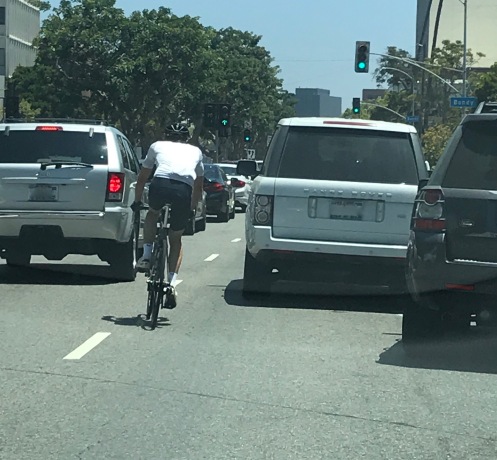
Ignoring
a dedicated bike lane, a cyclist dangerously splits lanes down San
Vicente Boulevard in West Los Angeles in mid-day traffic.
The video out of Brooklyn, New York on July 1 is as gut wrenching as
it is heart wrenching. A cyclist speeds down the sidewalk and into a
blind intersection, against the light, without slowing down. Tragically,
she tries to cross the street just as a cement truck enters the
intersection. She swerves at the last second, but it’s too late – she
hits the front of the truck, falls off her bike, and is crushed under
the truck’s back wheels. A surveillance camera caught the accident
(warning, the video
is extremely graphic and will be disturbing to some readers). The
victim was a 28-year-old woman named Devra Freelander, an artist who
lived in Brooklyn’s Bushwick neighborhood.
In Manhattan on June 24th, a
20-year-old bicycle messenger collided with a delivery truck in morning
traffic. Robyn Hightman was riding in traffic when they* hit the truck from
behind. The driver, who continued to drive several more blocks before being
flagged by a taxi driver, claimed he never saw them.
The accident occurred near the intersection of Sixth Avenue (aka
Avenue of the Americas) and 24th Street in Manhattan’s Chelsea district.
Ironically, in response to pressure from bike activists, in 2016 the
New York City Department of Transportation (DOT) installed a protected
bike lane on Sixth Avenue between 8th and 33rd Streets. In December of
that year Streetsblog NYC gushed
that “the new protected bike lane on Sixth Avenue … has turned one of
the city’s most stress-inducing bike routes into one of its best.”
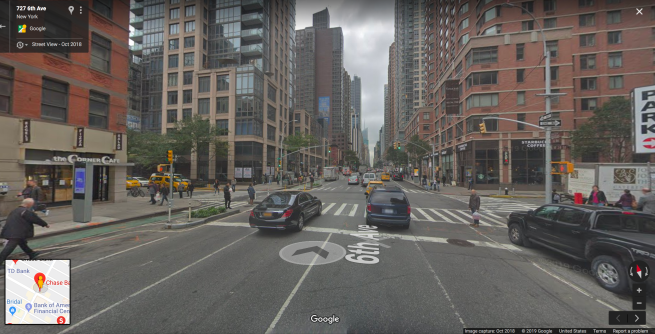
The
protected bike lane, left, on Sixth Avenue at 24th Street, near where a
cyclist was killed in an accident on June 24. The cyclist wasn’t using
the lane at the time of the collision.
According
to CBS affiliate WKTR, “police determined [Hightman] was not in the
bike lane and was traveling between vehicles when they were struck.”
Likewise, the New York Post reported
Hightman “was pedaling between cars” when the crash occurred.
Eyewitnesses, including the cab driver who stopped the truck driver,
confirmed that Hightman struck the Freightliner truck from behind.
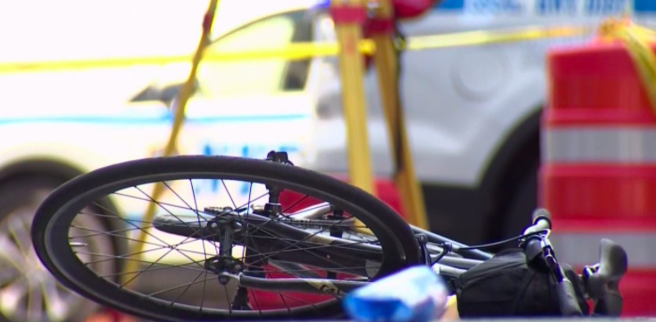
Images of the scene show a mangled bicycle in the middle of the street,
several dozen feet from the bike lane.
The response to the accident was predictable to anyone familiar with
bike activists and their radical agenda. Rather than using the tragedies
of Freelander’s and Highman’s deaths as a teachable moment New York’s
bike activists (all 37 of them) went into full outrage mode. Instead of
taking a hard look at the circumstances, they raged about “reckless
truck drivers,” “dangerous drivers,” and of course, “traffic violence.”
These are the same cohorts who gleefully boast about bike rage, and howl about evil school bus drivers (seriously). They even claim to be an “oppressed class” (again, seriously).
In short, they do everything but
take responsibility for their own lives.
Yet the simple fact is that
cyclists often are their own worst enemies. They routinely blow through red
lights and stop signs. They lane split in rush hour traffic while listening to
music and checking texts. They ride the wrong way down one-way streets. They
ride at night with no lights or reflective gear. They bait and taunt motorists.
These are all incredibly risky actions yet they are the norm for far too many
cyclists. If cyclists don’t take responsibility for their own safety, there’s
little the rest of us can do. Indeed, in the name of speed and convenience many
riders routinely ignore roadway features specifically intended to protect them.
A memorial gathering for Hightman the night of the accident was a
prime example of the activists’ warped ideology. What started as a
(relatively) peaceful vigil quickly turned into a protest that
ultimately erupted into an Antifa-style riot.
Several activists dragged two men from their car and beat them in the
street. They also damaged the men’s car along with multiple others.
Nothing calls sympathy to a cause like intentionally, violently
assaulting innocent individuals (not unlike the Antifa riot in Portland
last weekend that left journalist Andy Ngo with a brain hemorrhage).
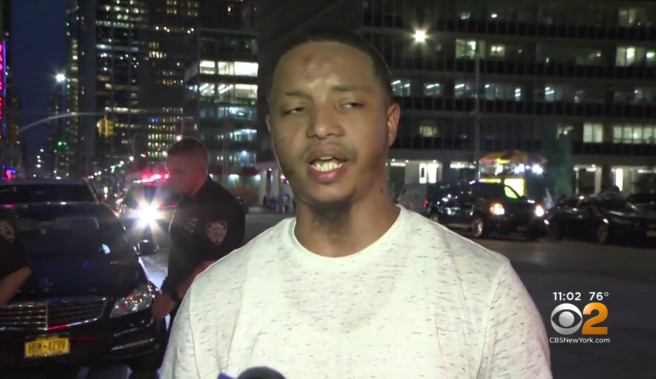
This man, with visible injuries, claims he was attacked by rioting bike activists.
Despite the activists’ self-righteous outrage and violence,
Freelander’s and Hightman’s deaths are tragic illustrations of how bike
lanes cannot prevent every single accident and death, particularly when
cyclists themselves don’t obey traffic rules. A reporter from the New
York Villager visited the scene of Hightman’s death a few days
after the accident. He observed, “several cyclists…veering out into car
lanes near the intersection to avoid heavy pedestrian traffic and slower
bicycles, and then turning back into the bike lane midway up the
block.” Cyclists swerve out into traffic in order to maintain their
preferred speed rather than slowing for pedestrians (as required by
law). That, in a word, is unsafe. If they won’t prioritize their own
safety, Vision Zero and all the bike lanes in the world can’t help them.
Activists often point to
confounding factors like cars, trucks, and buses parked illegally in bike
lanes. They point out that some drivers are simply oblivious to bicycles and
sometimes overtly hostile, with dangerous consequences. Those are valid points.
Again, however, the law requires bicycle riders to observe the rules of the
road. If a driver encounters a double-parked car, the solution isn’t to swerve
into the oncoming lane without slowing down. Given their inherent vulnerability
cyclists should be even more cautious. If they encounter a slower rider ahead
of them they have to slow down themselves until it is safe to pass. These are
the rules of the road.
Alas, a drive through most any
downtown core these days involves navigating among a constant scrum of law
breaking velocipedians. As bike lanes and other “bike infrastructure”
proliferate nationwide, attitudes among cyclists have shifted from self
preservation to privilege. Even though they comprise a vanishingly small proportion
of road users (with the exception of few college towns no U.S. city has a
bicycling rate higher than 4%), they wield outsize influence in city planning
offices and even city halls. Groups like New York’s Transportation Alternatives
are extremely well-funded and dominate the narrative over traffic safety. In
their narrative, cyclists are never responsible for their own actions, much
less their own safety.
If someone decides to drive drunk
and ends up crashing into a tree and dying, we don’t blame the tree. Yet in
every single cyclist death the activists blame everyone and everything but the
cyclist, even when that cyclist flouted traffic laws intended to protect them.
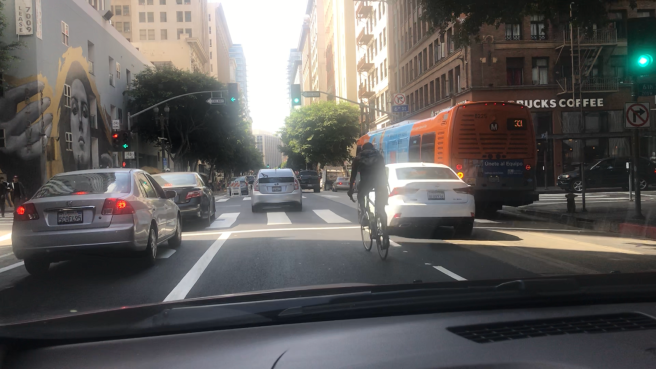
A cyclist ignores the protected bike lane and weaves through traffic on Spring Street in downtown L.A.
The fact that riders like Freelander are responsible for their own
accidents doesn’t make it their fault. Even when they’re 100%
responsible, they’re still victims. Victims of an increasingly entitled
and aggressive lobby of bike activists who blame everything on cars and
drivers even when the evidence to the contrary is overwhelming. It’s the
only message young people like Hightman have ever heard. They have
grown up in an era in which American cities collectively added tens of
thousands of miles of bike lanes, routes, and paths, giving riders a
sense of primacy. Cyclists are taught to ride aggressively rather than
cautiously and defensively. The ultimate tragedy is that it’s the bike
activists themselves who lure innocent people to their doom by imbuing
them with a false sense of priority and safety.
The fact of the matter is, choosing
to ride a bicycle is choosing to take certain risks. Cycling on city streets,
particularly major thoroughfares, is an inherently dangerous act, one made
inestimably more dangerous by many cyclists’ own conduct and decisions. When it
comes down to it there’s nothing between a rider’s body and the pavement.
Unless and until the bike activists
are willing to acknowledge so much as a scintilla of these realities people
will continue dying on the streets.